
The Science Behind Gamification: Why Competition Increases Member Motivation
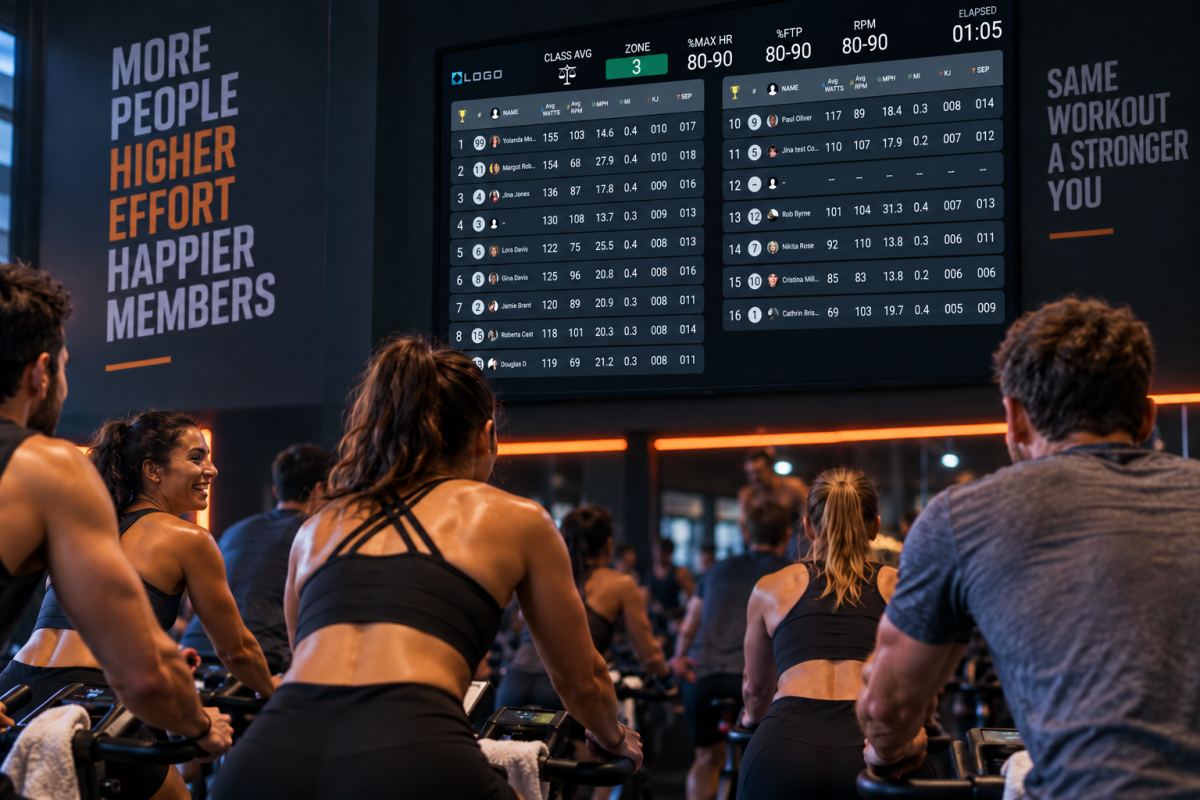
Watch a room of riders respond the first time a live leaderboard goes up. Pace picks up. Members start glancing at the screen during intervals they would have coasted through a minute earlier. The behavioral change is immediate and consistent enough across facilities that exercise researchers have been studying it for years. What happens when performance becomes visible turns out to be more predictable than most fitness professionals expect.
Why Visible Performance Changes Effort
Exercise research has been studying the social comparison effect for decades and the finding is consistent: people calibrate effort partly by what they can see happening around them. A member who notices the person two bikes over is working at 78% of their max, and who is at 65%, tends to adjust without being told to. The display creates a reference point. Nobody has to name it as competition for it to function that way.
The effect shows up across fitness levels and age groups. Members who describe themselves as non-competitive show similar effort responses when performance data is visible. The driver seems to be the gap itself: seeing the distance between where you are and where you could be creates a pull that doesn't require any explicit desire to win.
The Role of Achievable Targets
One condition matters most in motivation research: the target has to feel within reach. A gap that looks impossible to close in a reasonable time frame produces discouragement rather than effort. A gap closeable within the same class, or over a few sessions, produces the opposite. Gamification in fitness works well when the scoring system is built around this principle. A leaderboard based on raw output, where a first-timer is 40% behind the strongest person in the room, provides no useful target for most participants.
Zone-based scoring solves this by expressing performance relative to each person's own capacity. A member at 72% of their personal maximum can see they're a few percentage points behind someone at 79%. That gap is closeable within the same class, and the person at 79% is a meaningful reference point regardless of their absolute fitness level. The leaderboard becomes a set of achievable targets distributed across the whole room.
Personal bests function similarly. A member chasing their own previous record is engaged in a competition with a perfectly calibrated opponent. The target is always in range because it was set by their own performance. This is why personal best tracking tends to sustain motivation over longer time periods, past the point where the novelty of seeing a display has worn off.
What Gamification Actually Taps Into
The psychological mechanisms at work include more than competitiveness. Feedback loops are central: people respond differently to effort when they can see the result of that effort immediately. Riding harder and watching the output number climb is a feedback loop that closes in real time. Riders who get that feedback during the interval push differently than those who are working without it. The immediacy matters. A summary delivered after class has value; feedback delivered during the effort produces a different kind of behavioral response.
Progress and mastery are also part of the picture. A member who can track improvement over weeks and months develops a relationship with the program that's separate from any social comparison. The gamification element here is longitudinal: the record of past performances becomes the game. Members in this phase tend to show up more consistently, push harder during class, and stay with a program significantly longer than members who have no way to track their own trajectory.
Social belonging rounds it out. Team challenges, group milestones, and leaderboards that put members in proximity to others they recognize create social stakes around attendance. A person who is three days into a team challenge isn't making a fresh decision about whether to come on Thursday. The social dimension has already made it.
Why Effort-Based Scoring Matters for Retention
A leaderboard that measures raw output consistently puts the same people near the top. For the members who aren't near the top, it stops being useful information fairly quickly. The competitive dynamic collapses into a performance of the already-fit rather than an ongoing challenge for the full room.
Effort-based scoring preserves the competitive dynamic for everyone. A member who came three times last week and hit personal bests on two of those days has a genuine claim to a strong position on the effort leaderboard, regardless of how their absolute output compares to a more experienced athlete. That representation matters. Members who see themselves reflected accurately in the leaderboard engage with it longer and come back more consistently than ones whose effort is invisible in the ranking.
Where Spivi Fits
Spivi's scoring system is built around zone-based effort rather than raw output, so the competitive and motivational dynamics described above apply across the full member population, from beginners to experienced athletes. Real-time displays show performance during the session when it can actually change behavior. Post-session summaries push the record to the member app automatically, maintaining the feedback loop between classes. Challenges and milestones are built into the platform, providing the longer-arc motivational structures that sustain engagement past the first few weeks.
Frequently Asked Questions
Does gamification work for members who say they aren't competitive?
Usually. The social comparison research in exercise settings doesn't divide neatly along competitive personality lines. Effects show up consistently across both groups. What matters is visibility: seeing performance data changes behavior even for members who aren't consciously trying to beat anyone. The ones who say they're not interested in the leaderboard often engage with it within a few sessions, particularly once the scoring is based on effort rather than raw output and they can see themselves positioned alongside peers rather than at the bottom of a raw-output ranking.
Can gamification backfire and drive members away?
It can, in specific conditions. A raw-output leaderboard in a class with wide fitness variance tends to demoralize the middle and lower portion of the room fairly quickly, because the ranking reflects pre-existing fitness levels rather than the effort being put in. An anonymous option addresses some of this, but the underlying problem is the scoring model. Effort-based scoring designed around personal maximums avoids most of the backfire risk, because the leaderboard reflects something meaningful for everyone in the room.
How long does the novelty of a leaderboard last?
A few weeks for the purely novelty-driven engagement, but that's the wrong frame. The facilities that see sustained engagement with leaderboards tend to have scoring systems that keep producing new information: personal bests being set and broken, challenge leaderboards cycling on a four-to-six-week schedule, progress being tracked across months. The engagement question shifts from "is the screen interesting" to "do I have something to come back and improve." When the answer is yes, the display stays relevant indefinitely.
Our classes have a wide range of fitness levels. How does gamification work across that range?
Zone-based scoring handles this directly. When performance is expressed as a percentage of each member's personal capacity, a beginner working hard can rank higher than an experienced member coasting. The leaderboard reflects effort across the full range of participants, which is also the most honest representation of what happened in the room. Facilities with wide fitness variance tend to see the strongest benefit from switching to zone-based scoring, precisely because the gap between beginner and advanced is large in absolute terms but disappears when effort is the metric.
Do challenges improve retention, or just short-term attendance?
Challenges tend to do both, though the mechanisms are different. A four-week challenge typically spikes attendance during the challenge period. The retention effect depends on what happens around it: whether personal bests set during the challenge are tracked afterward, whether participants formed social connections with others in the challenge, whether there's another challenge visible on the calendar when this one ends. Challenges that exist in isolation tend to produce attendance bumps without lasting retention gains. Challenges built into a programming cycle with visible continuity produce both.
The Bottom Line
The research on competition and motivation in exercise settings isn't surprising once you've watched a room of riders respond to a leaderboard. Effort goes up when performance is visible. Progress gets tracked when there's something to track against. Members come back when the class has something specific they're returning for.
Gamification in group fitness works when the scoring system is calibrated for the full room and the competitive structures are built into how the program runs rather than added as a feature people can opt into. The facilities that get this right tend to find that member motivation isn't something they have to manufacture every class. The infrastructure does a significant portion of the work.
Want to see how Spivi's zone-based scoring and challenge tools work in practice?