
Functional Training Exercises
What is functional training:
Functional training is the one training that can help us daily. When carrying heavy bags from the supermarket, moving from sitting to standing, dealing with heavy luggage such as moving furniture and belongings without getting injured, carrying our children, and going upstairs without having to stop to breathe - functional training gives its fruits in our functional field, which simply improves our quality of life.
Unlike the classic training in gyms, the functional combines work on several muscle groups through exercises that mimic movements from everyday life or combined exercises that require inter-muscular coordinative ability or balance ability. Working on the muscular system through a complete and complex movement will improve the trainee's ability to perform movements from everyday life better and more efficiently, thus improving the quality of life.
The name of the training is derived from the word 'function', which is used in mathematics as a tool for expressing dependence between different variables. The dependence between the variables connects and associates them. In the field of strength training, the combination is between the movement, muscular, and nervous systems.
Core muscles:
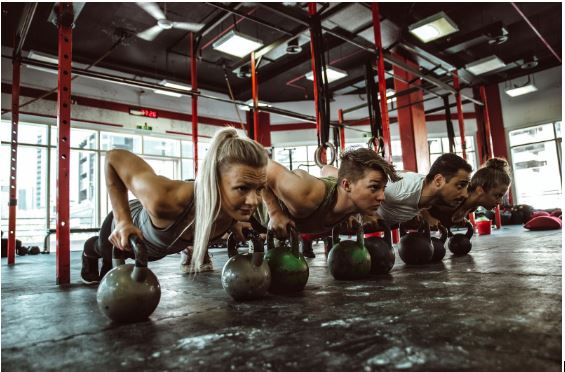
Most exercises in functional training require the mobilization of the core muscles to stabilize the pelvis and chest and maintain internal areas in the abdominal cavity. The reason is that the exercises are done without devices that stabilize the trainee's body, but in an open system against rubber bands, pit bulls, body weight, etc. Also, most exercises are not performed lying on the back but in standing, side-lying positions, or situations in which a significant part of the body is in the air with the support of hands, which requires the joint system to contract/reciprocate and coordinate to maintain static and dynamic body joints.
The functional training combines torso movements on all levels: bending, pushing, lateral bending, pelvic rotations, and spinal rotations. Both in dynamic and static work that stabilizes the torso while performing the exercise. These movements directly or indirectly strengthen the abdominal girdle, the internal and external muscles, which also include the rotating muscles of the spine that move and stabilize the vertebrae.

Functional training components:
- Natural movement related to daily life - the exercise should be natural and not forced or cumbersome.
- Use basic movements from daily life - pressing, pushing, pulling, lifting, lowering, squatting, rotation in the torso and neck, jumping, running with a change of direction, weight transfers from side to side, standing on one leg, etc.
- The movements must be related to the leading chains of movement that combine several muscles and connective tissue groups - myofascial chains.
- Resistance level, range of motion, number of repetitions/time, and intensity - higher than in everyday life to preserve and improve performance capabilities.
- Combining several fitness components. For example, a combination of push-ups, jumps, and deep squats combine strength, aerobics, flexibility, coordination, and even a few elements of speed and agility.
- Asymmetrical activity that combines work on balance, weight transfers, and activation of the core muscles.
- Pulse increase combined with cardiovascular aerobic components - work on several large muscle groups + core muscles + stabilization.
Types of functional training:
HIIT training
High-Intensity Interval Training belongs to the functional training group, with an emphasis on improving the endurance component. This method makes it possible to achieve exceptional results both in the visual aspect, body shape, and the aspect of physical fitness on most of its components, mainly muscular endurance and cardiopulmonary endurance, speed, coordination, and balance. Results are quickly noticeable to those who persist in this method. It is very available and accessible to carry out because it can be applied even without special equipment.
TABATA:
If you think 4 minutes is not enough, this workout will significantly undermine that thought. This is a private case of HIIT training. That is, the same characteristics we discussed in the HIIT training, only one fixed protocol that looks like this: 20 seconds of strenuous work, 10 seconds of rest, eight consecutive times.
CrossFit:
CrossFit training includes high-intensity interval training, weightlifting, various exercises from the field of apparatus gymnastics, aerobic elements, and explosive power. Unlike conventional fitness frameworks, the CrossFit training method does not focus on bodybuilding but on the level of physical fitness. Since the physical requirements of the various tasks in CrossFit training are not the same, they cause the activation of all the components of the various muscle cells. Moreover, the diversity in the number of repetitions in the various tasks not only improves muscular endurance or maximum strength but also brings about a combination of the two, stimulating the various bodily systems uniquely.
TRX straps:
The 3-letter combination is perhaps the most famous in the world of fitness equipment in recent years. These resistance straps can be used to work on every muscle and muscle in the body in an incredibly wide variety of exercises.
In Summary:
Many people train not only to improve themselves but also to keep their health and feel good about themselves. Functional training seeks to address the body's need to function daily. It works on several muscle groups at once and can be incorporated into the training program along with focused work on muscles and strength.